

Fereydun Adamiyat
Biography
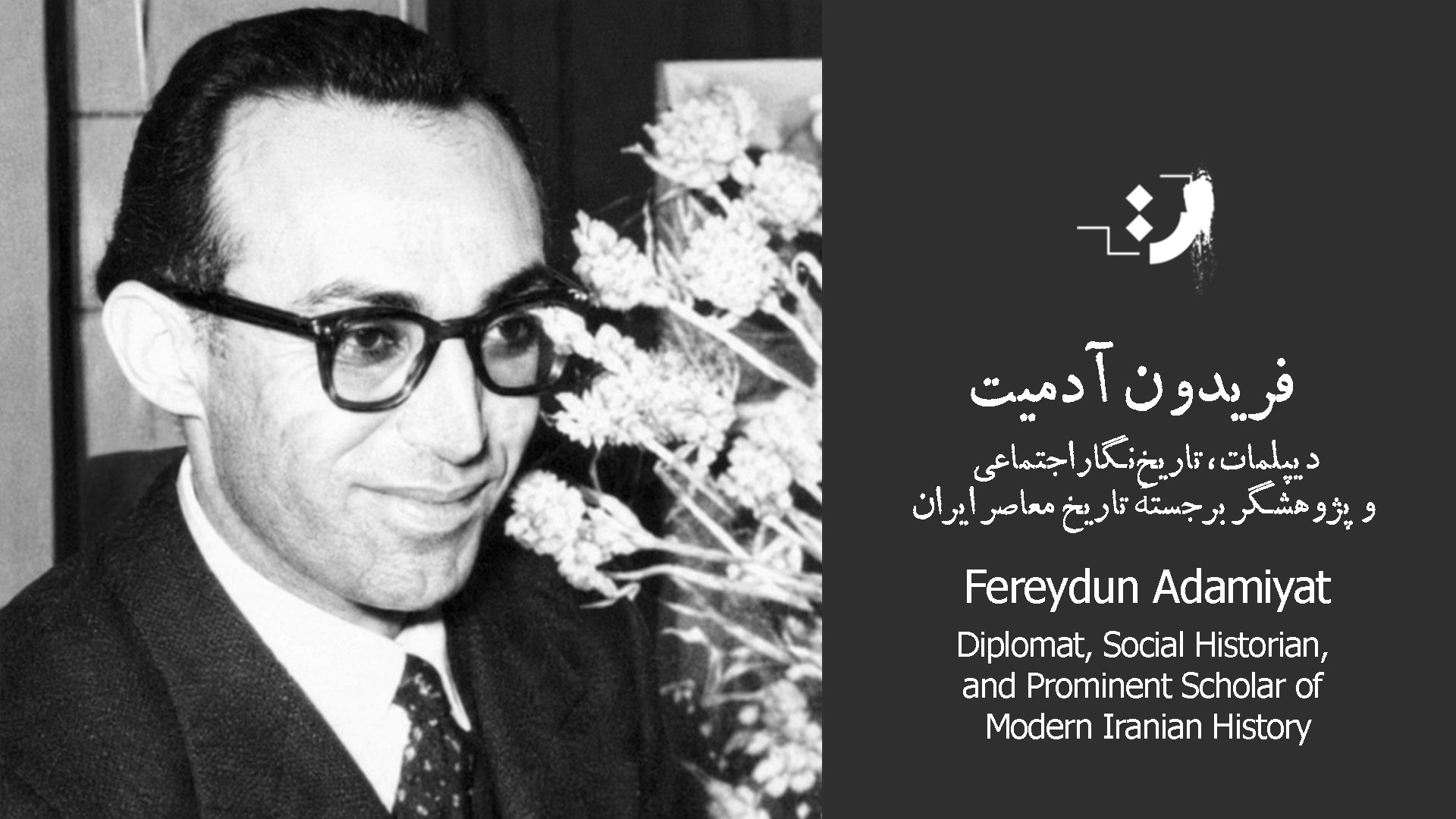
Fereydun Adamiyat, also spelled Fereidoon Adamiyat (23 July 1920 – 29 March 2008), was an Iranian diplomat, social historian, and prominent scholar of modern Iranian history. Born in Tehran into a family that had gained recognition during the final decades of the Qajar period, he was the son of Abbas-Qoli Khan Qazvini, commonly known as Abbasquli Adamiyat, a civil servant, political activist, and early advocate of liberal ideas during the Constitutional era.
Adamiyat became one of Iran’s most influential historians of the Qajar period and a pioneer of analytical historiography and intellectual history. His scholarship concentrated principally on modern political thought, reformist movements, the intelligentsia, and the ideological foundations of the Iranian Constitutional Revolution.
In 1971, he married Shahin-Dokht Enayat-Pour; they had no children. Despite declining health during the final decade of his life, he retained his intellectual abilities and continued to be regarded as a major figure in Iranian historical studies. He died in Tehran on 29 March 2008.
Education
Adamiyat studied at the School of Law and Political Science of the University of Tehran, receiving his bachelor’s degree in 1942. His undergraduate thesis examined the nineteenth-century reformist chief minister Mirza Taqi Khan Amir Kabir. This research later formed the basis of his best-known book, Amir Kabir and Iran.
While serving as a secretary at the Iranian embassy in London, he enrolled at the London School of Economics and Political Science in 1946. Under the supervision of Sir Charles Webster, he studied diplomatic and political history and completed his doctorate in 1949. His dissertation examined Persia’s diplomatic relations with Britain, the Ottoman Empire, and Russia between 1815 and 1830.
The intellectual environment of the LSE and the political atmosphere of postwar Britain had a lasting influence on him. Among the thinkers who particularly affected his outlook were the historian and social critic R. H. Tawney and the socialist political theorist Harold Laski.
Activities and Works
Adamiyat joined the Iranian Foreign Ministry in 1940 while still an undergraduate. During his diplomatic career, he held several important positions, including an eight-year attachment to Iran’s delegation to the United Nations. From 1961 to 1965, he served successively as Iran’s ambassador to the Netherlands and India.
His dissatisfaction with the direction of Iranian foreign policy eventually led to his early retirement from diplomatic service. He subsequently devoted himself entirely to historical scholarship. At the invitation of Gholam-Hosein Sadiqi, a leading historical sociologist and former minister in Mohammad Mosaddeq’s government, Adamiyat also taught briefly at the University of Tehran.
Adamiyat was for a time a member of the Iranian Writers’ Association and used his cultural and intellectual activities to support democracy and secular social-democratic ideals. Following the 1979 Revolution and the consolidation of clerical rule, he increasingly withdrew from public life. Continuing intimidation compelled him to leave Iran in October 1991. He lived briefly in Paris and later in Oxford and London, but his dislike of exile led him to return to Iran in May 1993.
Adamiyat regarded history as a specialized, analytical discipline. He emphasized the systematic examination of Iranian and foreign archives, the use of primary sources, and the classification of evidence according to its importance and reliability. His principal concern was the history of ideas, particularly the thought, careers, aims, and achievements of reformist intellectuals during the Qajar era.
He interpreted the Constitutional Revolution of 1906 as a movement intellectually nourished by an urban intelligentsia committed to liberty, democratic government, and national sovereignty. His work emphasized the significance of modern secular thought and challenged interpretations that placed clerical leadership and religious discourse at the center of the revolutionary process.
His notable works include:
Amir Kabir and Iran (Amir Kabir va Iran)
The Idea of Freedom and the Introduction to the Constitutional Movement
Studies of Qajar political thought, social movements, and reformist intellectuals
Bahrein Islands: A Legal and Diplomatic Study of the British–Iranian Controversy (1955)
Adamiyat was an admirer of Enlightenment modernity and an advocate of civic nationalism in the Mosaddeqist tradition. At the same time, he strongly criticized Western imperial domination, Orientalism, authoritarian government, and the political power of the clergy.
Achievements and Recognition
Adamiyat’s most important achievement was his role in establishing document-based, analytical historiography as a major approach to modern Iranian history. Through more than a dozen influential works, he helped make the intellectual history of Qajar Iran, constitutionalism, reform, and modernity central fields of historical inquiry.
His concise and assertive prose, extensive command of primary sources, and insistence on methodological rigor earned his works considerable attention. Although he published predominantly in Persian, his scholarship has frequently been cited by Western historians and Iranologists.
His methods and interpretations have also attracted substantial criticism. Scholars such as Abbas Amanat and Houchang Chehabi have criticized his tendency to divide historical figures into sharply opposing camps, his polemical language, his intense nationalism, his treatment of religious minorities, and his handling or quotation of some primary sources. His account of the Bábí movement in Amir Kabir and Iran has been particularly disputed on methodological and historical grounds.
Despite these controversies, Adamiyat has remained widely recognized—by admirers and critics alike—as a leading historian of modern Iran, an innovative scholar of constitutionalism and modern political thought, and a civically engaged intellectual committed to secular and democratic principles. No specific formal award is mentioned in the provided information; his principal distinction rests on the enduring scholarly influence of his writings and his pioneering position in modern Iranian historiography.
- Birthday: 23 July 1920
- Death: 29 March 2008
- Birthplace: Tehran, Tehran, Iran
Diplomat, social historian, and prominent scholar of modern Iranian history