
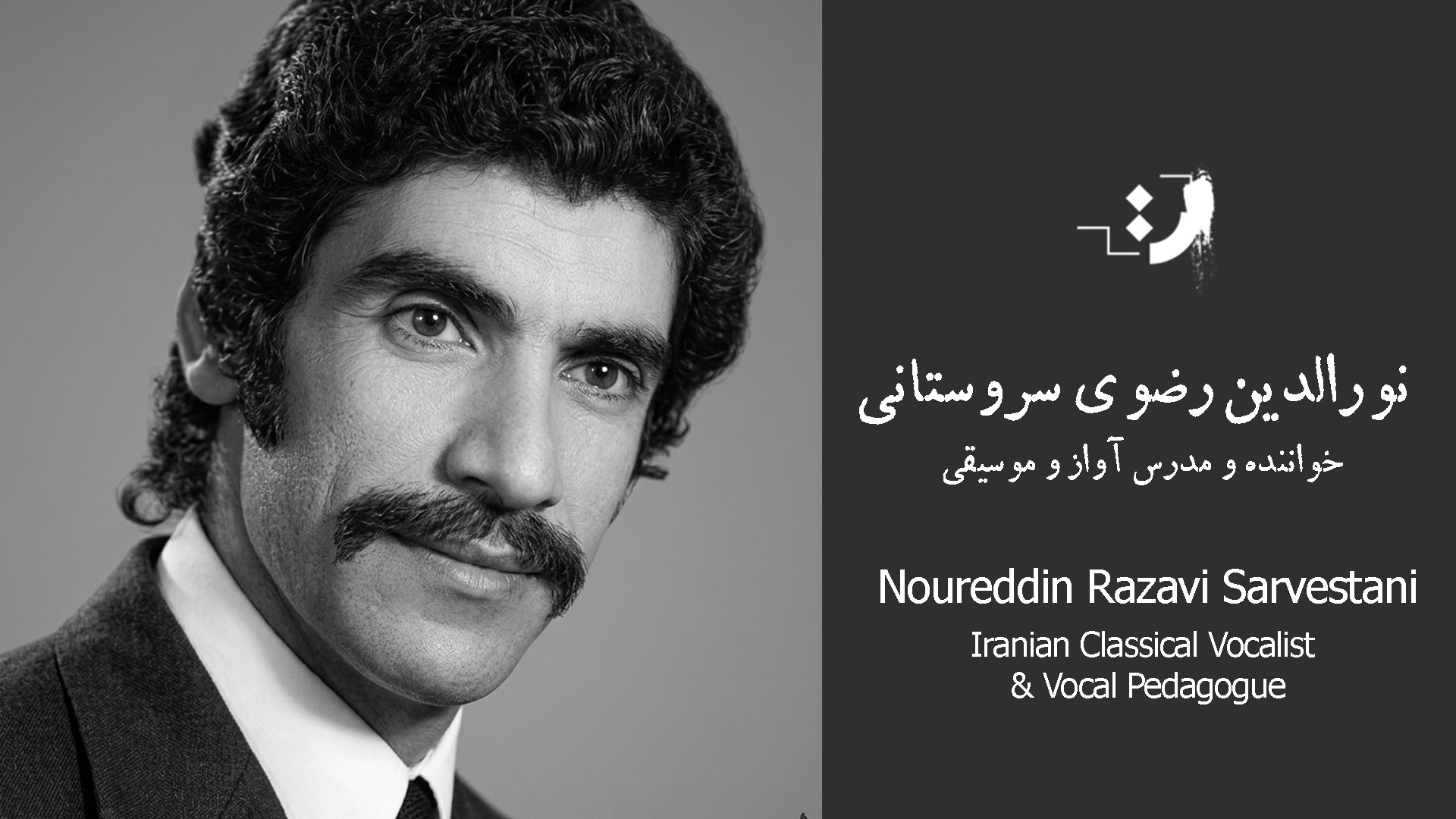
Noureddin Razavi Sarvestani
Biography
Seyyed Noureddin Razavi Servestani (April 10, 1935 – April 27, 2000) was an eminent Iranian classical vocalist, vocal pedagogue, and one of the foremost preservers of the Persian vocal tradition. Throughout more than four decades of artistic activity, he devoted himself to performing, teaching, and safeguarding the authentic styles of Persian classical singing. Renowned for his profound interpretation of the vocal repertoire (Radif), spiritual expression, and refined vocal technique, Razavi Servestani occupies a distinguished place in the history of Iranian classical music.
Education
Razavi Servestani was born in Servestan, Fars Province, Iran. His father was a stone mason who also performed Chavosh-khani (traditional pilgrimage chants) and Qur’anic recitation, providing his son with an early exposure to vocal traditions.
He began studying music seriously in his early twenties under Moshir Moazzam Afshar in Shiraz. In 1957, he moved to Tehran to further his musical education, studying with many of Iran’s leading masters, including Morteza Mahjoubi, Ahmad Ebadi, Reza Foroutan, Soleiman Amirghasemi, Ali-Akbar Shahnazi, Asghar Bahari, and most significantly Nour-Ali Boroumand, whose instruction profoundly shaped his artistic career. During this period, he became a fellow student and lifelong friend of Mohammad-Reza Shajarian.
In 1976, King Baudouin of Belgium awarded him an Honorary Doctorate in Music in recognition of his artistic achievements.
Activities and Works
Razavi Servestani’s voice was first broadcast on Radio Shiraz in 1958, marking the beginning of his professional career. Throughout his life, he remained committed to preserving the authentic traditions of Persian vocal music while developing a distinctive artistic style characterized by precision, elegance, and spiritual depth.
Beginning in 1973, he collaborated extensively with leading Iranian musicians and ensembles, including the Sheyda Ensemble, Samaei Ensemble, Darvish Ensemble, Molavi Ensemble, Parviz Meshkatian, Faramarz Payvar, and Hossein Alizadeh, performing numerous concerts both in Iran and internationally.
Following the 1979 Iranian Revolution, he spent much of the 1980s teaching in Shiraz before relocating to Tehran, where he continued teaching vocal music and served as a consultant, adjudicator, and artistic expert for the Ministry of Culture and Islamic Guidance. In 1999, he became a founding board member of the newly established Iran House of Music.
Among his most distinguished students are Sediq Ta’rif, Alireza Ghorbani, Hossein Alishapour, Pouria Akhavas, Abolhassan Mokhtabad, Alireza Vakili-Manesh, Mehdi Kolahdouz, and Ali Moradi.
His principal recordings include:
Rang-e Farah
Servestan
Navaye Ghorbat
Ba Man Sanama (with Parisa)
Nasim-e Sahar
Sanam-e Gorizpa
Advanced Vocal Radif of Noureddin Razavi Servestani
He is also widely remembered for his interpretations of classic Persian songs such as “Bia Tazeh Negar-e Man,” “Dar Be Sama’ Amadeh Ast,” and “Selseleh-ye Muy-e Doust.”
Achievements and Awards
Razavi Servestani is regarded as one of the most influential custodians of the Persian vocal tradition. His meticulous interpretation of the Radif and his lifelong dedication to preserving the vocal heritage of Iran have had a lasting impact on subsequent generations of singers.
His major distinctions include:
Honorary Doctorate in Music, conferred by King Baudouin of Belgium (1976).
Founding Board Member of the Iran House of Music (1999).
In 2012, a memorial ceremony was held in his honor at Hafez Hall in Shiraz, during which a commemorative statue and postage stamp were unveiled in the presence of renowned composer Hossein Alizadeh.
Razavi Servestani passed away on 27 April 2000 in Shiraz at the age of 64 and was laid to rest at the historic Hafezieh Mausoleum, one of Iran’s most revered cultural landmarks.
- Birthday: April 10, 1935
- Death: April 27, 2000
- Birthplace: Srvestan, Fars, Iran
Iranian classical vocalist, vocal pedagogue, and one of the foremost preservers of the Persian vocal tradition