

Ahmad Shamlou
Biography
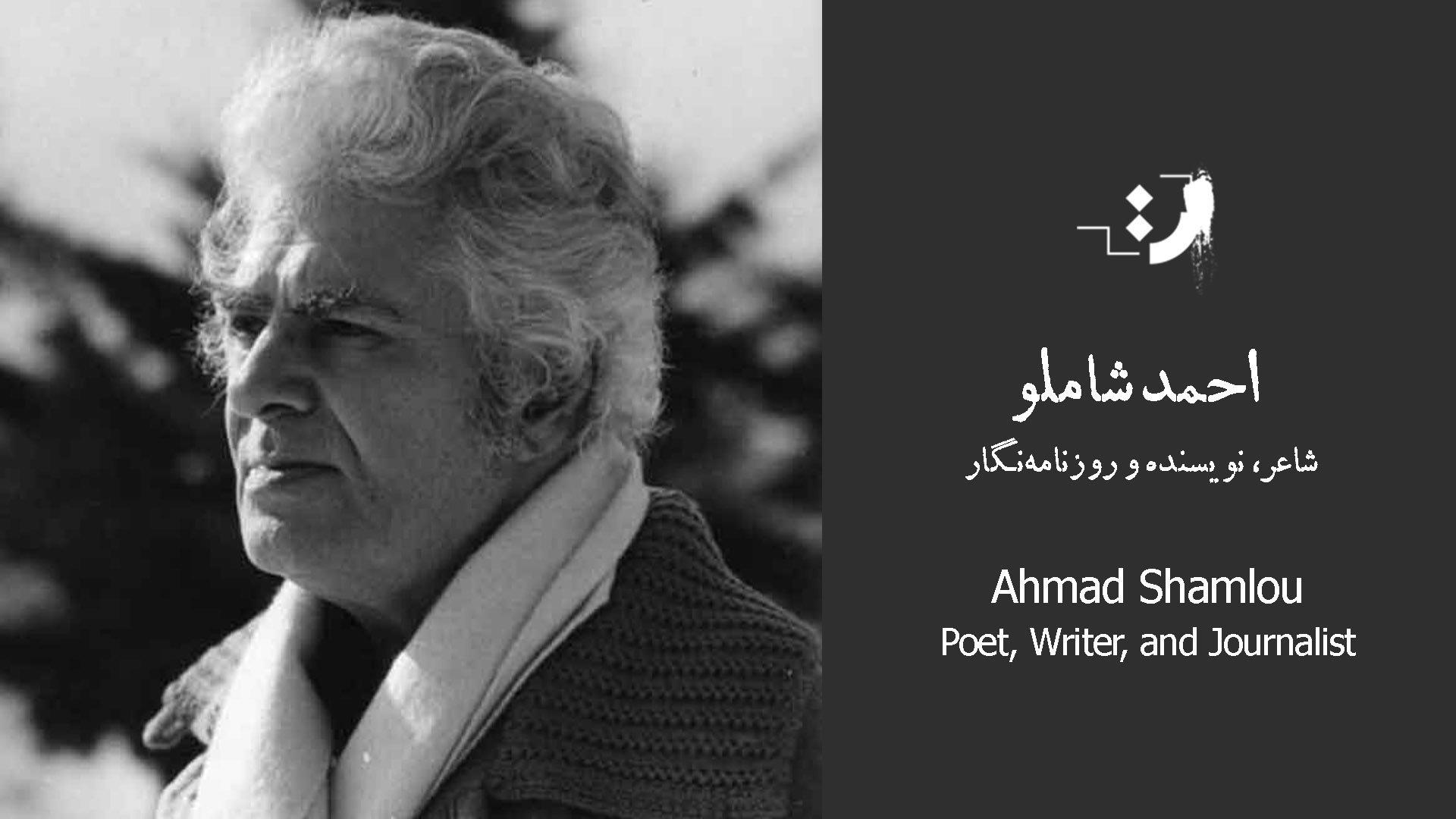
Ahmad Shamlou (December 12, 1925 – July 23, 2000) was one of the most influential figures in modern Persian literature. Known by the pen names “A. Bamdad” and “A. Sobḥ,” he was a poet, writer, translator, journalist, researcher, screenwriter, and lexicographer. Shamlou is widely regarded as the founder of She’r-e Sepid (“White Poetry” or Persian free verse), a major development in contemporary Persian poetry following the innovations of Nima Yooshij.
Early Life and Education
Ahmad Shamlou was born on December 12, 1925, in Tehran, Iran, into a military family. His father, Heydar Shamlou, was an army officer whose frequent assignments forced the family to move constantly from one city to another. As a result, Shamlou spent his childhood and adolescence in various cities including Rasht, Mashhad, Zahedan, Birjand, Gorgan, Urmia, Shiraz, and Isfahan. These continual relocations prevented him from having a stable formal education.
From an early age, he developed a strong interest in language and folk culture. As a teenager, he began collecting colloquial expressions and popular idioms—an interest that later evolved into his monumental encyclopedic work, Ketab-e Koocheh (“The Book of Alley”). He studied for a time at the Iran-Germany Technical School and learned German and French, but his formal education ended after political imprisonment during World War II.
Political and Social Activities
During the 1940s, Shamlou became involved in political activities. He was arrested for anti-Allied political activities during the occupation of Iran in World War II and spent time in prison. After the 1953 coup d’état against Prime Minister Mohammad Mossadegh, he was again persecuted due to his political activities and journalistic work, leading to further imprisonment.
Shamlou was also an active member and secretary of the Iranian Writers’ Association, consistently advocating freedom of expression and writers’ rights. His political and cultural views often generated controversy and intense public debate. In his later years, despite illness and increasing restrictions on his activities, he continued writing and conducting research.
Literary and Cultural Activities
Ahmad Shamlou is considered one of the greatest modern Persian poets. After meeting Nima Yooshij in 1946, he initially embraced Nimaic poetry but later moved beyond traditional poetic meter and created a distinctive style known as White Poetry. The publication of collections such as Qat‘nameh (“Manifesto”) and later Havaye Tazeh (“Fresh Air”) established him as a pioneering modernist poet.
Besides poetry, Shamlou worked extensively in journalism and literary publishing. He served as editor or collaborator for influential literary magazines such as Ketab-e Hafteh (“Book of the Week”), Khosheh, Ketab-e Jomeh (“Friday Book”), and Ferdowsi. Through these publications, he introduced and supported a new generation of Iranian writers and poets.
Shamlou was also an accomplished translator. He translated works by Federico García Lorca, Langston Hughes, Margot Bickel, Zacharia Stancu, Antoine de Saint-Exupéry, and many others into Persian.
Ketab-e Koocheh (The Book of Alley)
One of Shamlou’s most important scholarly achievements was Ketab-e Koocheh, a comprehensive encyclopedia of Iranian folk culture compiled with the collaboration of his wife, Aida Sarkissian. The work documents Persian idioms, proverbs, stories, customs, and popular traditions and is considered one of the most valuable references on Iranian folklore and colloquial Persian culture.
Personal Life
Shamlou married three times. His first marriage was to Ashraf ol-Molouk Eslamiyeh, with whom he had four children: Siavash, Sirous, Saman, and Saqi. His second marriage to Toosi Haeri also ended in separation. His most enduring and influential relationship was with Aida Sarkissian, whom he married in 1964. Aida had a profound impact on both his life and poetry, inspiring many of his most celebrated love poems.
Major Works
Some of Ahmad Shamlou’s most important poetry collections include:
- Ahanghaye Faramoosh Shodeh (“Forgotten Songs”)
- Qat‘nameh (“Manifesto”)
- Havaye Tazeh (“Fresh Air”)
- Bagh-e Ayeneh (“Mirror Garden”)
- Aida dar Ayeneh (“Aida in the Mirror”)
- Aida: Derakht va Khanjar va Khatereh (“Aida: Tree, Dagger, and Memory”)
- Ebrahim dar Atash (“Abraham in Fire”)
- Dashneh dar Dis (“Dagger in the Dish”)
- Taranehaye Koochak-e Ghorbat (“Little Songs of Exile”)
- Madayeh Bi-Selah (“Unrewarded Praises”)
- Dar Astaneh (“At the Threshold”)
- Hadis-e Biqarari-ye Mahan (“The Tale of Mahan’s Restlessness”)
His notable translations and research works include The Little Prince, Gilgamesh, Eastern Song, The Barefoot, and Ketab-e Koocheh.
Awards and Achievements
Throughout his life, Shamlou was invited to universities and literary conferences around the world, including Berkeley, Princeton, and Harvard, where he delivered lectures and poetry readings. His works have been translated into numerous languages, including English, French, German, Spanish, Swedish, and Japanese.
In 1983, he was nominated for the Nobel Prize in Literature. After his death, the “Ahmad Shamlou Poetry Award” was established in his honor and remains one of the most prestigious poetry awards in contemporary Persian literature.
Death
After years of illness, Ahmad Shamlou passed away on July 23, 2000, at his home near Tehran. He was buried in Imamzadeh Taher Cemetery in Karaj. His funeral attracted thousands of admirers, and his grave remains an important cultural and literary landmark in Iran.
- Birthday: December 12, 1925
- Death: July 23, 2000
- Birthplace: Tehran, Tehran, Iran
Poet, writer, translator, journalist, researcher, screenwriter, and lexicographer