

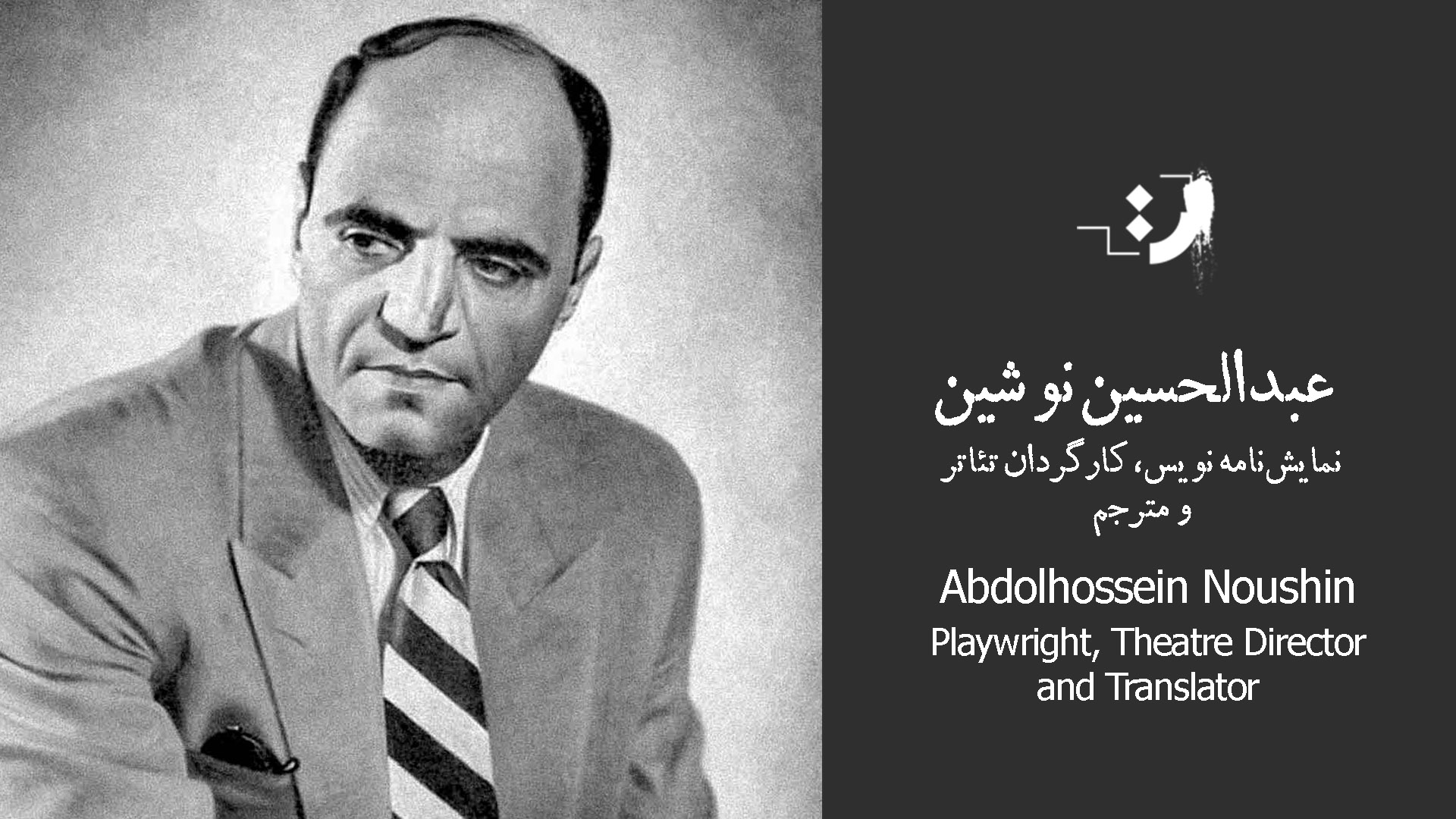
Abdolhossein Noushin
Biography
Abdolhossein Noushin (c. 1906 – May 2, 1971) was an Iranian playwright, theatre director, translator, and pioneer of modern Western-style theatre who emphasized professional standards, Stanislavski’s system of naturalistic acting, and disciplined preparation in his productions.[1][2]Born into a religious family in Mashhad, Noushin completed early education there before studying at Tehran’s Dar ul-Funun high school and traveling to France in 1928 initially for history and geography, later shifting to theatre training at Toulouse’s conservatory and further studies in French literature and performing arts, returning to Iran in 1932 equipped to elevate local stagecraft.[1] He co-founded the Kānūn-e Ṣan‘atī Art Group that year, staging translations of French plays and original works, including Marcel Pagnol’s Topaze in which he starred, as well as Shahnameh-inspired tableaus like Zal and Rudabeh and Rostam and Tahmineh, often collaborating with intellectuals such as Mohammad Ali Forughi and his wife, Armenian actress Loreta, whom he married in 1934.[2][1] Noushin established the Farhang Theater, participated in Moscow’s 1937 theatre festival, and trained influential actors including Ezzatollah Entezami and Nosratollah Karimi, fostering a generation that professionalized Iranian theatre amid Lalehzar Street’s cultural vibrancy in Tehran.[1]As a central committee member of the communist Tudeh Party, Noushin’s political activism intertwined with his artistic career, leading to his 1949 arrest—alongside other party affiliates—after an assassination attempt on Mohammad Reza Shah Pahlavi, resulting in a 10-year prison sentence; he escaped in 1950, hid for about 20 months, then fled to the Soviet Union, where he continued limited work but could not return to Iran despite later overtures, marking the abrupt end of his domestic theatrical prominence.[2][1][3] This exile, prompted by the Tudeh’s banning post-1948, underscored tensions between intellectual leftism and monarchical authority, though his foundational role in importing and adapting Western drama techniques endured through his protégés and productions’ emphasis on empirical rehearsal rigor over traditional improvisation.[1]
Early Life and Education
Childhood and Family Background
Abdolhossein Noushin was born in 1906 in Mashhad, the capital of Khorasan province and a major center of Shia Islam in Iran, into a religious family.[4] [1] Little is documented about his immediate family members, such as parents or siblings, but the religious context of his upbringing in Mashhad likely influenced his early exposure to traditional Persian-Islamic cultural norms, which contrasted with his later adoption of Western theatrical influences.[1]He completed his elementary education in Mashhad, demonstrating early academic aptitude in a setting dominated by religious schooling and local traditions.[1] This foundational period ended when he relocated to Tehran as a youth, marking a transition from provincial religious life to the more cosmopolitan environment of the capital, where opportunities for secular education expanded.[1]
Formal Education in Iran and Europe
In Tehran, Noushin pursued secondary studies at Dar ul-Funun high school, graduating with a diploma in 1307 SH (1928 CE) and securing a spot among the first Iranian students dispatched abroad by the government to acquire modern expertise as part of Reza Shah’s educational reforms.[5] [1]Noushin traveled to France in 1928 initially to study history and geography. He enrolled at the Conservatoire d’Art Dramatique in Toulouse to study theater, but his scholarship was canceled, prompting an early return to Iran. He later returned to France at his own expense to continue studies in French literature and performing arts, focusing on acting, stagecraft, and Western theatrical traditions, before returning to Iran in 1311 SH (1932 CE).[1] [5] This period equipped him with foundational skills in modern European theater, which he later applied to Iran’s nascent dramatic scene.[6]
Professional Career in Theater
Pioneering Modern Theater in Iran
Abdolhossein Noushin returned to Iran in 1932 after studying theater and performing arts in France, where he had shifted from initial history and geography coursework to formal training at the conservatory in Toulouse and further studies in French literature.[1] His early efforts focused on professionalizing theater by applying Western production standards, including detailed script analysis, collaborative roundtable discussions among casts, and casting selections based on actors’ physical attributes, skills, and personal inclinations rather than arbitrary choices.[1]In the 1930s, Noushin staged Marcel Pagnol’s Topaze (translated as People), performing the lead role himself and demonstrating a commitment to high-quality, scripted performances over improvisational or traditional forms.[1] During the 1934 Ferdowsi millennial celebrations, he directed and acted in historical tableaus drawn from the Shahnameh, such as Zal and Rudabeh, Rostam and Qobad, and Rostam and Tahmineh, collaborating with figures like Mohammad Ali Forughi and Mojtaba Minovi; he portrayed Rostam, while his wife, actress Loreta, played female leads like Tahmineh and Rudabeh, whom he married that year.[1] These productions marked an early fusion of Persian epic narratives with modern directorial techniques, elevating theater’s status amid Iran’s cultural modernization under Reza Shah.[1]Noushin pioneered the introduction of the Stanislavski system to Iran, adapting its emphasis on naturalistic acting, psychological depth, and character immersion—methods then prominent in Europe and North America—to local contexts.[1] He trained actors to eschew formulaic recitations, instead encouraging imaginative exploration of characters’ off-script lives while enforcing disciplined rehearsals to achieve authentic performances.[1] Through his leadership at theaters like Farhang, Ferdowsi, and Sa’di, he mentored a generation of key figures, including Ezzatollah Entezami, Nosratollah Karimi, and Mahin Deyhim, whose subsequent work perpetuated these methods and professional norms.[1]His innovations extended beyond technique to institutional practice, as he was the first in Iran to conduct theater work with meticulous diligence, prioritizing accuracy and collaboration over ad hoc traditions.[1] In 1937, Noushin, Loreta, and actor Hosein Kheyrkhah represented Iran at Moscow’s theater festival, after which he refined his approaches through additional European study, solidifying his role in bridging global modernism with Iranian performance arts.[1] These efforts established foundational standards for modern Iranian theater, influencing fields from stage acting to cinema long-term.[1]
Key Productions, Translations, and Innovations
Noushin’s innovations included rejecting traditional Iranian ta’zieh performances in favor of scripted, actor-centered productions that prioritized natural dialogue and psychological depth, influencing subsequent generations of Iranian directors by embedding realist techniques.[1]In 1950, while in hiding after escaping prison, he guided the production of Oscar Wilde’s Lady Windermere’s Fan at the Saadi Theater in Tehran, marking one of the first full-scale adaptations of British comedy of manners for Iranian audiences, complete with period costumes and set designs adapted to local contexts while preserving the original’s satirical tone.[7][1]Noushin personally translated numerous Western plays to suit Iranian sensibilities, favoring straightforward prose over ornate language to enhance accessibility and performance flow.[4] Notable translations include William Shakespeare’s Othello, rendered into Persian with attention to cultural equivalents for idiomatic expressions, and a collaboration with poet Nima Yushij on Much Ado About Nothing, which adapted Elizabethan wit into colloquial Persian for staged readability.[8][9] These works exemplified his innovation in bridging European dramaturgy with Persian linguistic norms, often incorporating subtle ideological undertones aligned with leftist realism to critique social hierarchies.
Literary and Intellectual Contributions
Translations of Western Works
Abdolhossein Noushin contributed significantly to Iranian theater by translating key Western dramatic works into Persian, prioritizing accurate renditions suitable for stage performance and emphasizing textual fidelity over loose adaptations prevalent in earlier efforts. His translations, often undertaken in the 1940s for productions at venues like the Tehran National Theater, introduced modern European dramatic techniques and themes to Iranian audiences, bridging traditional ta’zieh rituals with secular Western forms.[1][9]Among his verified translations is William Shakespeare’s Othello, rendered as Atello, a tragedy exploring jealousy and racial prejudice, which Noushin adapted with attention to poetic structure, drawing on iambic pentameter equivalents in Persian verse. This work, completed prior to his 1949 arrest, served as a foundational text for professional Iranian stagings and was later published, influencing subsequent translators through its methodological rigor.[10][11]Noushin also collaborated with poet Nima Yushij on Shakespeare’s comedy Much Ado About Nothing, translated as Heyahoye Besiyar baraye Hich, capturing the original’s verbal sparring, situational irony, and Elizabethan wordplay while rendering it accessible for Persian theater. This translation, praised for balancing literal accuracy with performative fluency, exemplified Noushin’s approach to preserving dramatic rhythm and cultural nuances without ideological overlays.[9][12]These efforts extended to other classical Western plays, though comprehensive lists remain limited due to archival losses following political upheavals; contemporaries noted his systematic translations of European repertoires as instrumental in professionalizing Iranian drama, distinct from his later Soviet-influenced works.[2][13]
Original Writings and Theoretical Works
Noushin’s most prominent original theoretical work is Honar-e Theater (The Art of Theater), a foundational text that introduced systematic principles of modern dramatic production to Iran during the 1940s, emphasizing rigorous methodology over traditional improvisational forms.[14] The book drew from his studies in Europe and the Soviet Union, advocating for structured actor training, stagecraft, and narrative coherence to elevate theater as an intellectual and social force, countering the era’s rudimentary performances.[15]In addition to theoretical exposition, Noushin authored original adaptations and scenarios from Ferdowsi’s Shahnameh, including film scripts and theatrical outlines that integrated epic narratives with contemporary staging techniques, produced during his leadership of theater groups in the 1940s.[16] These works exemplified his effort to indigenize modern theater by reinterpreting Persian heritage through scripted, non-traditional lenses, often prepared for ensemble performances under his direction.[17]Noushin contributed scholarly writings on Shahnameh, notably Gozareshi Chand Darbareh-ye Shahnameh (Several Reports on the Shahnameh), which analyzed textual variants.[14] He also penned essays, glossaries like Vazhe-ye Namak (a terminological compendium), published sporadically in periodicals to explore literary and ideological themes aligned with his Marxist influences.[18] These pieces, often disseminated through party-affiliated channels, reflected his broader intellectual commitment to synthesizing Eastern classics with proletarian realism, though many remained unpublished or circulated in limited manuscripts due to political suppression.[16]
Political Involvement and Ideology
Affiliation with the Tudeh Party
Abdolhossein Noushin was a founding member of the Tudeh Party of Iran, established on October 2, 1941, as the country’s primary Marxist-Leninist organization advocating for workers’ rights, land reform, and opposition to monarchy under Reza Shah Pahlavi.[3] His early involvement aligned with the party’s recruitment of intellectuals during World War II, when Soviet influence in northern Iran facilitated leftist activities amid Allied occupation.[2]Noushin served on the Tudeh Party’s Central Committee, a key leadership body responsible for ideological direction and organizational strategy, reflecting his status among prominent cultural figures drawn to the party’s platform of class struggle and anti-imperialism.[1] Through this role, he contributed to the party’s cultural front, leveraging his theater expertise to promote progressive dramas and translations that critiqued feudalism and capitalism, though specific party-directed productions remain sparsely documented in primary records.[6]His affiliation underscored the Tudeh’s appeal to Iran’s modernist elite, yet it exposed tensions between artistic autonomy and party discipline, as Noushin’s pro-Soviet leanings—evident in his advocacy for dialectical materialism—influenced but did not fully subsume his independent theatrical innovations.[19] Party membership records, often clandestine due to repression, confirm his active participation until the 1949 crackdown following the failed assassination attempt on Shah Mohammad Reza Pahlavi, which prompted a nationwide ban on Tudeh activities.[1]
Ideological Positions and Soviet Influences
Noushin’s ideological positions were rooted in leftist politics, particularly through his membership in the Tudeh Party of Iran, a communist organization established in 1941 that advocated Marxist-Leninist principles of class struggle, anti-imperialism, and proletarian internationalism.[1] As a member of the party’s central committee, he integrated these views into his theatrical endeavors, selecting plays that addressed social injustices and political critique to foster audience awareness of contemporary issues in Iran during the post-Reza Shah era of relative political openness.[1] His approach emphasized theater as a tool for ideological education, conducting roundtable discussions with actors to align performances with broader socialist goals, reflecting a commitment to naturalism and disciplined artistry over mere entertainment.[1]Soviet influences profoundly shaped Noushin’s ideology and practice, stemming from his exposure to Russian theatrical traditions and direct engagements with the USSR. He adopted Konstantin Stanislavski’s “system” of acting, which prioritized psychological realism and emotional authenticity—methods developed in pre- and early Soviet Russia and disseminated through Soviet cultural institutions—introducing them to Iranian theater via his Farhang Theater group.[1] In 1937, Noushin and his wife Loreta were invited to Moscow’s international theater festival, where interactions with Soviet performers reinforced his appreciation for state-supported, ideologically oriented drama that combined artistic innovation with political messaging.[1] His collaboration with Soviet-trained Armenian actor Vahram Papazian, whom he invited to Iran, further embedded these techniques, emphasizing ensemble discipline and social realism in productions.[1]Following his 1949 arrest amid the Tudeh Party’s suppression after an assassination attempt on Mohammad Reza Shah, Noushin fled to Moscow on party orders, residing there until his death in 1971 and deepening his immersion in Soviet cultural and ideological frameworks.[1] This exile solidified his pro-Soviet stance, as the Tudeh’s alignment with Moscow’s foreign policy—evident in its support for Soviet interests during the 1940s Azerbaijan and Kurdistan crises—mirrored Noushin’s own prioritization of international communist solidarity over nationalist sentiments.[1] His students, including figures who later trained in Moscow, perpetuated these influences, adapting Stanislavski’s methods to Iranian contexts while maintaining a focus on plays with implicit leftist critiques, though political repression in the 1950s curtailed overt ideological theater.[1]
Arrest, Imprisonment, and Death
Circumstances of Arrest in 1949
On February 4, 1949, an assassination attempt was made on Shah Mohammad Reza Pahlavi in Tehran by a gunman disguised as a news photographer, with no affiliation to the Tudeh Party.[4] Although the attacker was not connected to communist groups, the Iranian government under Prime Minister Hossein Ala used the incident as a pretext to intensify suppression of leftist elements, declaring martial law, banning the Tudeh Party, and launching mass arrests of its members on charges of subversion and conspiracy against the monarchy.[4] [2]Abdolhossein Noushin, a prominent intellectual and founding figure in modern Iranian theater who served on the Tudeh Party’s central committee, was arrested in this crackdown shortly after the attempt, targeted for his leadership role and ideological alignment with the party’s pro-Soviet stance.[1] [20] The arrests reflected broader geopolitical tensions, as the Tudeh Party had been accused of collaborating with Soviet interests following the 1946 withdrawal from Iranian Azerbaijan, though direct evidence tying Noushin personally to espionage remains undocumented in primary accounts.[6] He was charged specifically with membership in the banned party’s central committee, reflecting the government’s view of such affiliations as inherently seditious amid Cold War-era suspicions of communist infiltration in cultural and intellectual circles.[1]The wave of detentions, including Noushin’s, involved security forces raiding homes and offices of suspected sympathizers without warrants, often under emergency powers invoked post-attempt, leading to the imprisonment of thousands of Tudeh affiliates across Iran.[2] This action dismantled Tudeh’s public activities, including Noushin’s theater initiatives, which had been platforms for disseminating progressive and Marxist-influenced ideas through adaptations of Western plays.[20]
Conditions and Duration of Imprisonment
Noushin was sentenced to three years’ imprisonment in 1949 for his membership in the Tudeh Party’s central committee following the attempted assassination of Mohammad Reza Shah Pahlavi, though some accounts report a 10-year sentence; sources conflict on the exact term.[1] [2] He served only a few months before escaping prison, as directed by Tudeh Party officials, amid a broader crackdown on communist affiliates.[1]Specific conditions of Noushin’s imprisonment remain sparsely documented, with no primary accounts detailing treatment, facilities, or daily hardships endured by political prisoners at the time. While in custody, he maintained indirect involvement in theater by advising his wife, Loreta Hairapetian, on productions such as Oscar Wilde’s Lady Windermere’s Fan.[1] The escape marked the end of his incarceration in Iran, after which he hid for about 18 months—primarily at the home of director Ezzatollah Entezami—before exiling himself to the Soviet Union.[1]
Cause and Circumstances of Death
Abdolhossein Noushin died of stomach cancer on May 2, 1971, at the age of 65, while in political exile in Moscow.[1] After escaping from Qasr Prison, where he was held as a Tudeh Party leader following the 1949 assassination attempt on Mohammad Reza Shah, and hiding for about 18 months, he fled to the Soviet Union, where he resided for the remainder of his life, engaging in literary and theatrical work under state patronage.[21] [22]The illness progressed over approximately one year, leading to his hospitalization in Moscow, where he succumbed despite medical care available in the USSR.[22] No evidence from contemporary accounts suggests foul play or unnatural causes; his death is consistently attributed to the cancer in reports from Iranian exile circles and Soviet records. In his final moments, Noushin reportedly expressed a wish to be buried in Iran, though his remains were interred in Moscow’s Vostryakovskoye Cemetery.[21][22]
Legacy and Reception
Influence on Iranian Theater and Culture
Abdolhossein Noushin is recognized as the father of modern Iranian theater for introducing Western dramatic techniques and professional standards in the mid-20th century. After studying theater and performing arts in France from 1928 to 1932, including at the conservatory in Toulouse, he returned to Iran equipped with methods such as the Stanislavski system, emphasizing naturalistic acting, discipline, and in-depth play analysis through discussions.[1] [4] This marked a shift from traditional forms like ta’zieh to secular, text-based drama, fostering a generation of actors trained in realistic performance styles.[1]Noushin founded the Farhang Theater, which became a cultural hub on Lalehzar Street in Tehran, staging both translations of Western classics and original works infused with social themes. He directed pre-exile productions such as Marcel Pagnol’s Topaze in the 1930s and William Shakespeare’s Othello (1948, based on his translation at Farhang Theater).[1] [4] [2] His ensemble, the Arts’ Ensemble (Kānūn-e San‘at), co-founded in the 1930s, promoted fidelity to original texts using accessible language and trained influential figures like Ezzatolah Entezami and Nosratollah Karimi, elevating overall production quality. Groups associated with him later staged works like Oscar Wilde’s Lady Windermere’s Fan (1951 at Sa’adi Theater) and Emmanuel Roblès’ Montserrat before the 1953 coup.[2] [23]Despite interruptions from his 1949 arrest and subsequent exile to the Soviet Union, Noushin’s emphasis on progressive, internationally informed theater left enduring effects, bridging Western traditions with Iranian contexts and influencing post-WWII dramatic practices through his students and the persistence of his established methods.[1] [4] His work professionalized the field, making theaters accessible to the intelligentsia and middle class while embedding social commentary, though shaped by Marxist-Tudeh affiliations that prioritized ideological content.[2]
Political Legacy and Controversies
Noushin’s political legacy is primarily associated with his role in leveraging theater as a vehicle for Tudeh Party propaganda, introducing Soviet-influenced theatrical techniques that emphasized ideological messaging over pure artistry. As a central committee member of the Tudeh Party, he directed plays with leftist undertones, such as adaptations promoting class struggle and anti-imperialist themes, which helped establish modern Iranian theater’s politicized framework during the 1940s.[1] His adoption of the Stanislavski system, honed through Soviet contacts including the 1937 Moscow theater festival, trained a generation of directors and actors who perpetuated these methods, influencing post-1953 underground cultural resistance despite official suppression.[1] However, this legacy remains niche, confined largely to leftist intellectual circles, as his overt alignment with Soviet communism alienated broader Iranian society amid Cold War tensions and the monarchy’s anti-communist stance.[6]Controversies surrounding Noushin stem from his deep Tudeh involvement, which critics viewed as prioritizing foreign Soviet directives over national interests, including alleged facilitation of party subversion through cultural fronts. His 1949 arrest following the assassination attempt on Shah Mohammad Reza Pahlavi led to a 10-year sentence for central committee activities, after which he escaped, hid, and fled to Moscow, actions interpreted by authorities as evidence of organized sedition.[1] From exile, he continued advising Tudeh-affiliated productions.[1] Detractors, including post-coup regime officials, forced associates to publicly denounce him, highlighting fractures in the theater community and underscoring Tudeh’s use of culture for espionage-adjacent agitation, as documented in declassified accounts of the party’s Moscow ties.[6] His death in Moscow on May 2, 1971, without returning despite requests, fueled narratives of disloyalty, limiting official rehabilitation even among reformist factions wary of communist legacies.[1] These elements reflect broader debates on intellectual complicity in ideological extremism, with Noushin’s case exemplifying how Soviet-oriented leftism clashed with Iran’s sovereignty aspirations.
- Birthday: 1906
- Death: May 2, 1971
- Birthplace: Mashhad, Khorasan, Iran
Playwright, Theatre Director and Translator