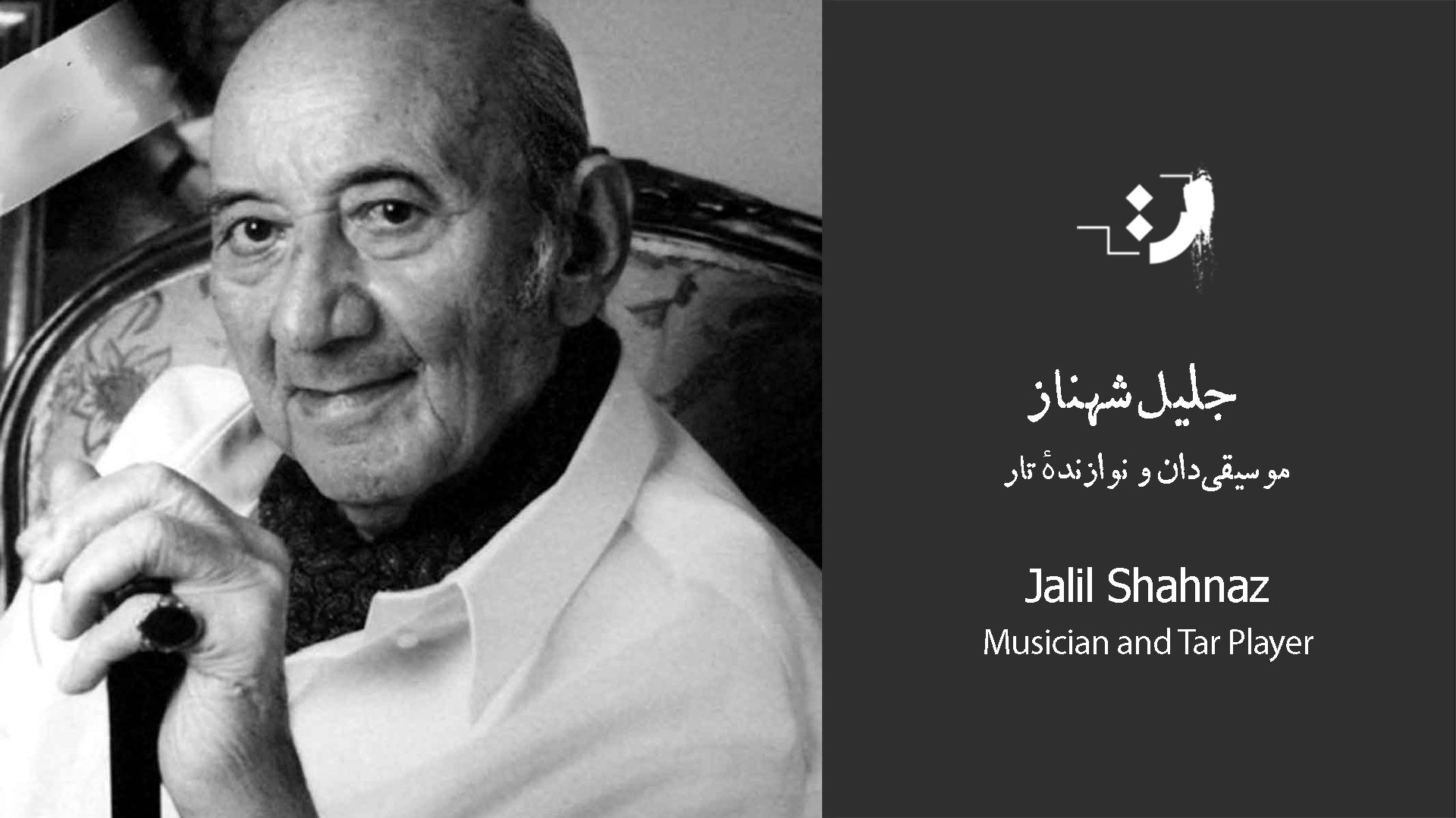
Jalil Shahnaz
Biography
Jalil Shahnaz (May 22, 1921 – June 17, 2013) was a legendary Iranian musician and one of the greatest virtuosos of the tar, a long-necked string instrument used in Persian classical music. His expressive and innovative playing style earned him a revered place in the history of Iranian music.
Early Life and Musical Education
Jalil Shahnaz was born in 1921 in Isfahan, Iran, into a family deeply rooted in traditional Persian music. His father, Shaban Khan, was a dedicated musician who played tar, setar, and santur. His uncle, Gholamreza Sarang, was a well-known kamancheh (spike fiddle) player. Encouraged by his family, Jalil began learning tar from his elder brother, Hossein Shahnaz, at a young age. His talent and dedication quickly brought him recognition in Isfahan’s musical circles.
Professional Career
Shahnaz began his professional career in 1949 at Radio Isfahan, and in 1957, he was invited to join Radio Tehran, where he became a soloist in the famous Golha (Flowers) program. He also collaborated with major orchestras such as Hosein Yahaghi’s Orchestra and performed with many legendary Iranian artists, including Hassan Kassai, Faramarz Payvar, Parviz Yahaghi, Homayoun Khorram, Ali Tajvidi, and Mohammad-Reza Shajarian.
In the 1980s, he became a founding member of the Iranian Music Masters Ensemble, which toured extensively in Europe, Asia, and the United States. He was also an active participant in the Shiraz Arts Festival and performed in numerous prestigious national and international events.
Musical Style and Legacy
Shahnaz was admired for his vocal-like phrasing on the tar, often described as deeply emotional and improvisational, echoing the intricacies of Persian classical singing. His mastery of the Persian musical radif (modal system) and his exceptional ability in duet (javab-e avaz) performances set him apart. His artistry inspired generations of musicians, and renowned vocalist Mohammad-Reza Shajarian named his musical ensemble “Shahnaz” in his honor, calling him his spiritual mentor in music.
Recognition
In 2004, Shahnaz was named an “Eternal Figure of Iranian Music”, and he received the First-Class Art Certificate (equivalent to a Ph.D. in the arts) from the Iranian Ministry of Culture. His contribution to Persian music is considered unmatched, and many believe that “with him, the book of tar playing was closed.”
Death and Commemoration
Jalil Shahnaz passed away on June 17, 2013, in Tehran at the age of 92. He was laid to rest in the Artists’ Section of Behesht-e Zahra Cemetery. His death was mourned across the Iranian music community and beyond, with tributes from artists such as Mohammad-Reza Shajarian, who stated, “Only the title ‘master’ suits Jalil Shahnaz—his tar created in me a passion that shaped my musical path.”
Selected Works
“Atr Afshan” (Tar solo with tombak accompaniment by Mohammad Esmaeili)
“Zaban-e Tar” (Tar solo with Jahangir Malek on tombak)
“15 Pieces for Tar & Setar”, transcribed by Houshang Zarif
Numerous live and studio recordings with legendary vocalists like Mohammad-Reza Shajarian, Shahram Nazeri, and Hossein Khajeh Amiri
Concert of Iranian Masters of Music, performed with the Iranian Music Masters Ensemble
Influence
Shahnaz collaborated with many of the greats of Iranian music and influenced countless students and musicians. His style, known for its lyrical richness and intricate ornamentation, continues to inspire tar players around the world.
- Birthday: May 22, 1921
- Death: June 17, 2013
- Birthplace: Isfahan, Isfahan, Iran
Musician and Tar Player