

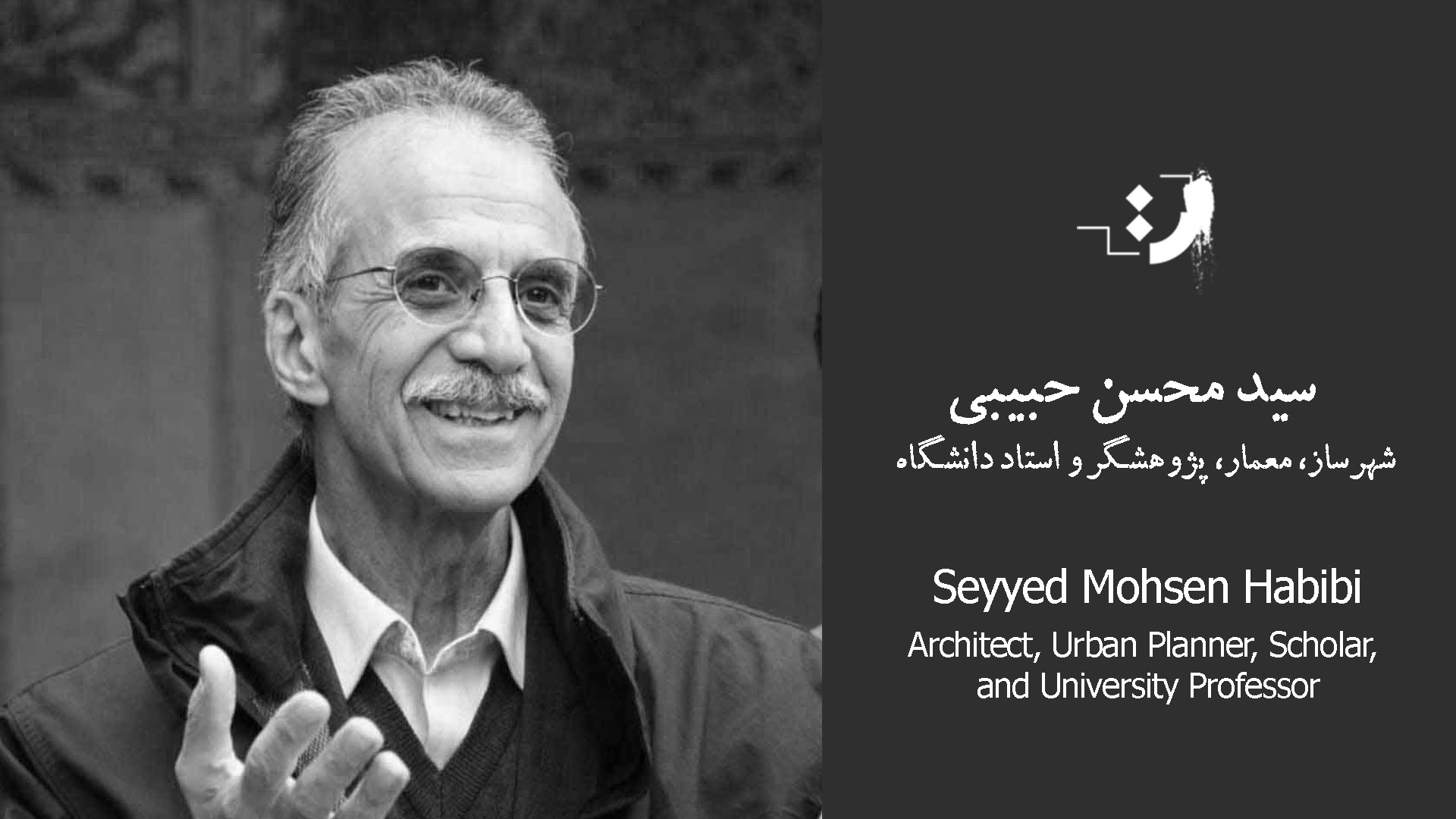
Seyyed Mohsen Habibi
Biography
Seyed Mohsen Habibi was an Iranian architect, urban planner, scholar, and university professor. He was born on August 21, 1947, in Kermanshah, Iran, into a family with strong literary and cultural interests. His father, Seyed Mojtaba Habibi, was a judge and jurist with a deep appreciation for classical and modern Persian literature. His father’s extensive library introduced Habibi to Iranian history, culture, and literature at an early age.
After completing high school, Habibi moved to Tehran to pursue higher education. His studies at the Faculty of Fine Arts of the University of Tehran laid the foundations of his academic and professional career in architecture and urban planning. The history, culture, everyday life, and spatial structure of Iranian cities remained central to his teaching, research, and professional work throughout his life.
Habibi became a full professor of urban planning at the University of Tehran and educated several generations of Iranian architects, urban planners, and researchers. Some academic and journalistic sources have referred to him as the “Father of Iranian Urban Planning.” He died in Tehran on September 27, 2020.
Education
Habibi received his high-school diploma in mathematics from Shapur High School in Kermanshah in 1965. In 1967, he entered the architecture program at the Faculty of Fine Arts, University of Tehran.
For his final architecture project, titled “Redesigning the Center of Karand,” he examined the history of the area, its inhabitants’ way of life, and the customs of the Ahl-e Haqq community. This contextual and culturally grounded approach later became a defining feature of his scholarly work.
Habibi continued his education in urban planning at the University of Tehran. Under the supervision of Manouchehr Tabibian, he completed a master’s thesis titled “The Evolution of Urbanization and Urban Planning in Iran” and graduated in 1976.
In 1977, after receiving an overseas scholarship from Bu-Ali Sina University in Hamadan, he traveled to France and pursued advanced studies at the Institut Français d’Urbanisme at Paris 8 University. His doctoral dissertation, “The City in Iran: From the Traditional City to the Modern City,” examined the transformation of Iranian cities and the interaction between tradition and modernity in the country’s modernization process.
He completed his doctorate in urban planning in 1981 under the guidance of scholars including Pierre Merlin, Françoise Choay, Anatole Kopp, and Yves Lacoste.
Activities and Works
After returning to Iran, Habibi worked at the engineering office of the Hamadan Governorate and later at the Building and Housing Research Center. In 1983, he joined the University of Tehran as an assistant professor and subsequently attained the rank of full professor.
His principal academic appointments included:
Head of the Department of Urban Planning at the University of Tehran, 1985–1989
Director of Graduate Studies at the Faculty of Fine Arts, 1997–2001
Vice Dean for Academic Affairs at the Faculty of Fine Arts, 2001–2004
Dean of the Faculty and Campus of Fine Arts, University of Tehran, 2004–2009
Habibi was also involved in major urban-planning initiatives in Tehran. He served on the strategic council responsible for guiding Tehran’s comprehensive development plan, participated in the city’s specialized planning council, and advised the Technical and Development Deputy of Tehran Municipality.
He held a number of research and advisory positions within the Ministry of Housing and Urban Development. These included serving as Deputy for Housing Research at the Building and Housing Research Center, adviser to the center’s director, member of the Scientific Council of the Center for Architectural and Urban Studies, and member of the ministry’s Social and Economic Council. He also advised Iran’s Cultural Heritage Organization and collaborated with the Housing Foundation of the Islamic Revolution.
Habibi approached the Iranian city through history, architecture, philosophy, poetry, literature, cinema, and social movements. His scholarly output included numerous books, translations, and a substantial body of academic and research articles on architecture, urban planning, housing, and Iranian urban culture.
His principal books include:
Minimum Housing
Housing Construction Patterns in the Cities of Khuzestan
Housing and People with Disabilities
Principles and Regulations for the Design of Regions, Villages, and Residential Units
The Structure of Tehran
Urban Land-Use Standards
Urban Restoration
Atlas of the Tehran Metropolis
The Story of the City: Tehran as the Symbol of the Modern Iranian City, 1920–1953
An Account of the Intellectual Currents of Architecture and Urban Planning in Contemporary Iran
From Shar to Shahr: A Historical Analysis of the Concept and Physical Form of the City
The Isfahan School: The Language of Urban Design in Historic Cities
The Story of the City
Memory of the City
Baharestan Square: An Experience of Modernity in Iranian Urban Space
His major Persian translations include:
What Is a Region?
The Architecture of Reconstruction in France
Urban Space and People with Disabilities
Françoise Choay’s Urbanism: Utopias and Realities
The Technology of the Dome
Achievements and Awards
Seyed Mohsen Habibi is regarded as one of the most influential figures in contemporary Iranian urban studies. His major contribution was the integration of historical and cultural inquiry with architectural and urban-planning research. Through his teaching and publications, he helped establish a deeper understanding of the Iranian city and its transformation from traditional to modern forms.
In 2002–2003, he was selected as an Exemplary Professor of the University of Tehran. He was also recognized on several occasions as a distinguished researcher, author, and enduring figure in Iranian urban planning.
In 2018, the French government appointed him a Chevalier in the Order of Academic Palms in recognition of his academic and scholarly contributions. His books, teaching methods, and culturally informed interpretation of Iranian cities remain an important legacy in the fields of architecture and urban planning.
Ahmad Nourizadeh was an Iranian poet, literary scholar, translator, journalist, and researcher. He was born in November 1951 in Ghazian, Bandar Anzali, northern Iran. Through several decades of translating and introducing Armenian literature, history, and culture to Persian-speaking audiences, he became recognized as the founder of Armenian studies in the Persian language in Iran.
Nourizadeh was one of the very few non-Armenian literary figures—and reportedly the only non-Armenian poet in the world—who composed poetry in Armenian. His contribution was highly regarded in Armenia, where he was affectionately described as “the Persian-speaking son of the Armenian nation.”
He also had experience in journalism and served as the editor of the political desk of the Ettela’at newspaper before the Iranian Revolution. During the final years of his life, he lived under medical and social care at the Kahrizak Charity Foundation because of multiple sclerosis. Nourizadeh died on August 23, 2021, at the age of 69.
Education
Nourizadeh studied Armenian language and literature directly with prominent Armenian teachers. He learned the Armenian alphabet in less than six months under the guidance of the Armenian poet Arshi Babayan. He later continued his language training with Khajak Der-Grigorian, head of the Armenian Studies Department at the University of Isfahan.
Although the available information does not mention a formal university degree, his extensive knowledge of Armenian language, literature, history, and culture earned him an honorary professorship from Yerevan State University in 2001.
Activities and Works
Nourizadeh began translating and introducing the works of Armenian poets in 1969–1970. His career encompassed literary translation, historical and cultural research, poetry, authorship, and journalism. Over more than four decades, he played a central role in introducing Armenian cultural heritage to Iranian readers and published approximately seventeen books.
One of his most influential works was One Hundred Years of Armenian Poetry: Selections from More than Seventy Armenian Poets, published in 1990 with an extensive introductory study of Armenian history and culture.
His notable translations include:
The Apple Garden, Rain, and Several Other Stories, featuring works by fifteen prominent Armenian writers
Autumn in Flight by Varand Kurkjian
Peter the First by Alexei Tolstoy
One Hundred Years of Armenian Poetry
Tsolak by Axel Bakunts
The Twenty-Six Commissars, or the Baku Commune by Hrachya Kochar
Red Songs, a collection of poems by Yeghishe Charents
O Homeland! O Homeland!, a collection of poems and stories by Hovhannes Tumanyan
Blue Love Poems, a poetry collection by Vahagn Davtyan
Amalia, a novel by Nar-Dos
His principal authored works and poetry collections include:
The History and Culture of Armenia
Greetings to You, Armenians, a collection of poems in Armenian
In the Night of Solitude and Dreams, a collection of Armenian poems
Let the Arabian Jasmines Spread Their Fragrance, a collection of Persian poems
In the Night of Solitude and the Winter of the World, a collection of Persian poems
Achievements and Awards
Nourizadeh’s work created an important cultural bridge between Iran and Armenia. Armenian writers and critics praised him as one of the foremost translators of Armenian literature and regarded his contribution as an exceptional phenomenon in Armenian literary history.
His major honors include:
The Appreciation Award from the Writers’ Union of Armenia
The Garbis Papazian International Cultural Award, Austria, 2000
The Movses Khorenatsi Medal, Armenia’s highest cultural distinction, presented by President Robert Kocharyan, 2001
An honorary professorship from Yerevan State University, 2001
The Kantegh Grand Prize of the Writers’ Union of Armenia, 2005
The Gold Medal of the Ministry of Culture of the Republic of Armenia for his extensive cultural contributions, September 26, 2011
- Birthday: August 21, 1947
- Death: September 27, 2020
- Birthplace: Kermanshah, Kermanshah, Iran
Architect, urban planner, scholar, and university professor