
Zabih Behrouz
Biography
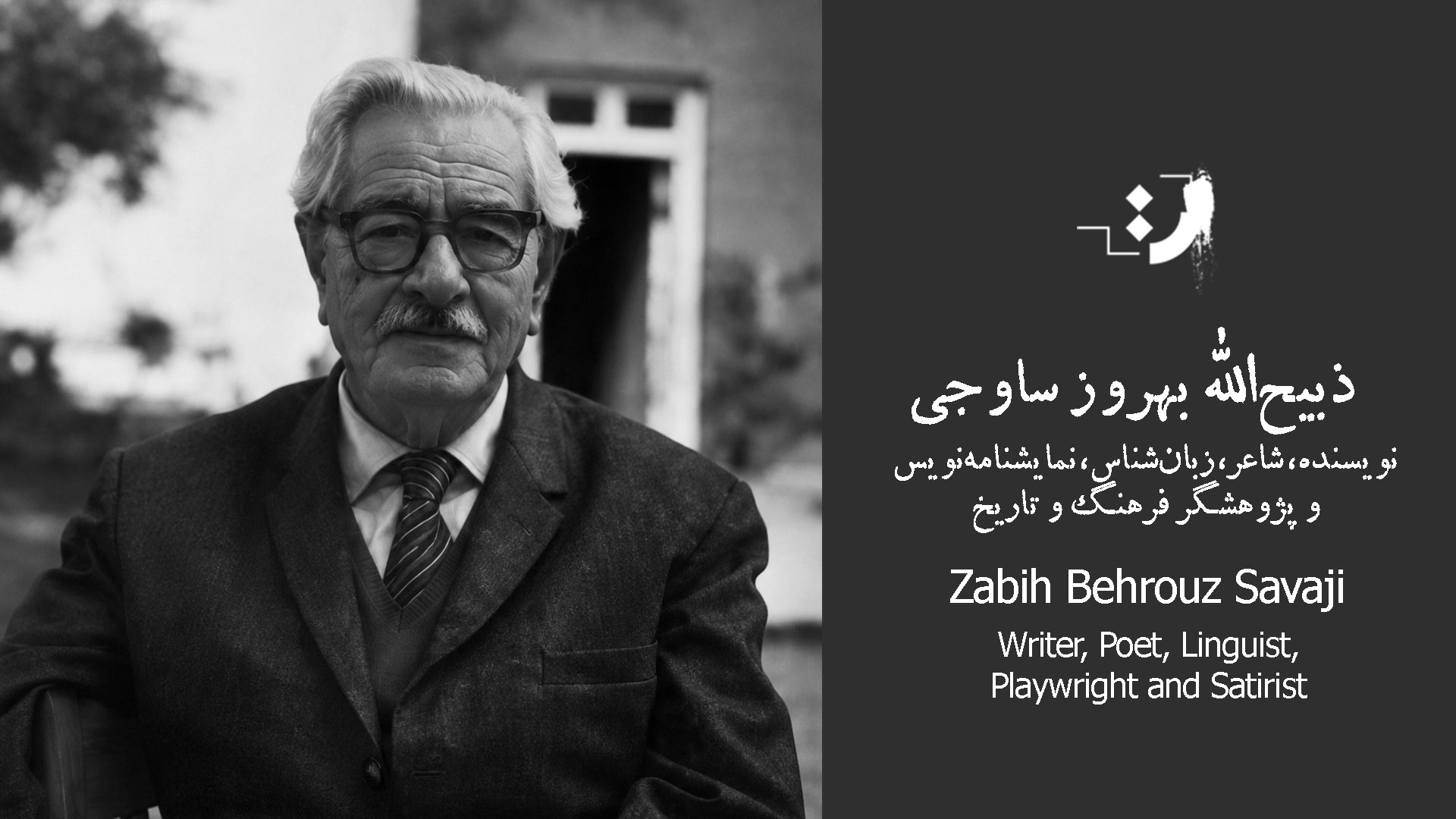
Zabih Behrouz Savaji (17 July 1890 – 12 December 1971) was an Iranian writer, poet, linguist, playwright, satirist, and researcher of Iranian history and culture. Born in Tehran, he was the son of Mirza Abu’l-Fazl Savaji, a noted physician and calligrapher.
Behrouz spent a significant part of his education and early scholarly career in Egypt and Europe. After returning to Iran, he worked in several governmental, educational, and military institutions and eventually retired with the equivalent rank of brigadier general. His interests included the Persian language and script, ancient Iranian calendars and astronomy, literary satire, drama, and cultural history.
He became known for questioning the methods and conclusions of certain Western Iranologists and for advocating a strongly nationalist interpretation of Iranian history. Some of his historical and linguistic theories—including his views on Alexander the Great, Manichaeism, and the origins of writing—were highly unconventional and have been criticized as inconsistent with established scholarship.
Behrouz died in Tehran on 12 December 1971.
Education
Behrouz began his education in a traditional maktab and later attended the American College in Tehran, where he learned English. In 1911, he traveled to Cairo to continue his studies in Arabic language, literature, and traditional Islamic learning. He remained in Egypt for approximately ten years and became fluent in Arabic.
He subsequently moved to England. At the University of Cambridge, he studied mathematics and worked as Edward G. Browne’s Persian-language teaching assistant. He was also associated with Reynold A. Nicholson, the prominent scholar of Persian literature and Islamic mysticism. After leaving England, Behrouz spent time in Germany and Italy before returning to Iran.
Activities and Works
Following his return to Iran, Behrouz worked briefly for the oil industry and the Ministry of Finance and occasionally served as an interpreter for Reza Shah. He later taught Arabic and English at institutions including Dar al-Fonun, the Officers’ College, the Higher School of Commerce, and the Army Aviation College. He also became honorary head librarian of the Army Officers’ Club and served on a Ministry of War commission responsible for coining Persian equivalents for foreign terminology.
Behrouz advocated reform of the Persian script and the replacement of Arabic-derived vocabulary with words of Persian origin. Together with his students Mohammad Moqaddam and Sadeq Kia, he founded the Iran-Vij Society. Its publication series, Iran-Kuda, became the principal forum for disseminating his linguistic, historical, and cultural ideas. His work on Persian military terminology also contributed to the intellectual environment that preceded the establishment of Iran’s first language academy.
As a satirist and playwright, Behrouz criticized autocracy, social hypocrisy, the Qajar court, and certain traditions of Orientalist scholarship. His best-known play, Jijak Alishah, is a satire on life at the Qajar court. He frequently used historical characters and settings to comment on contemporary political and social conditions.
His principal works include:
Ayin-e Bozorgi
Me‘raj-nameh, published under the pen name Ebn Deylaq
The Three-Hundred-and-Fifty-Year Manichaean Calendar, unpublished
The Royal Nowruz Calendar
Calendar and History in Iran
Jijak Alishah
Script and Culture
Reading and Writing in Two Weeks
In the Way of Mehr
In the Way of Mehr, Volume II, unpublished
The Language of Iran: Persian or Arabic?
The King of Iran and the Armenian Lady
A Ferdowsi Night
A Concise Arabic-to-Persian Dictionary
Selections from the Divan of Hafez
Gand-e Badavard (The Wind-Blown Stench)
Achievements and Awards
No specific formal award is mentioned in the supplied information. His principal achievements include:
Teaching Persian and collaborating with Edward G. Browne at Cambridge
Teaching languages and literature at several major Iranian institutions
Conducting research on Iranian chronology, astronomy, and the history of writing
Contributing to the development of Persian equivalents for military terminology
Co-founding the Iran-Vij Society with Mohammad Moqaddam and Sadeq Kia
Disseminating linguistic and historical studies through the Iran-Kuda series
Producing influential works of Persian parody, burlesque, and satire
Writing historically themed critical plays, particularly Jijak Alishah
- Birthday: 17 July 1890
- Death: 12 December 1971
- Birthplace: Tehran, Tehran, Iran
Writer, poet, linguist, playwright, satirist, and researcher of Iranian history and culture